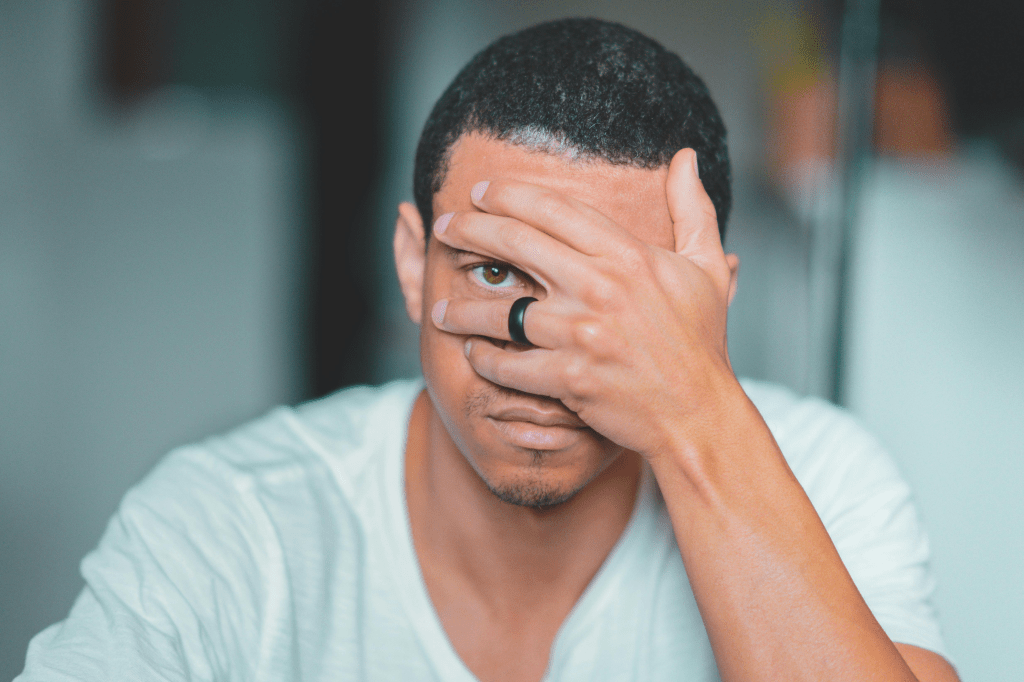
Staring Contest

A friend’s blog post on being an Asian girl in a White world had me reflecting on how people like me (i.e., non-Asians) are treated here in Japan. As a white guy in an Asian world, it will come as no surprise that I get stared at. A lot. Everywhere I go, old people break their necks gawking at me, little kids lock their eyes on me like they’re about to launch laser-guided missiles, and everyone of every age in between stares wide-eyed and mouth agape as though they’d never seen a white guy before. (I write this recognizing that as a white, American man, I’m undoubtedly on top of the minority hierarchy here.) 

I tell myself they can’t help but look. I consider myself of middling size and average features back home, but here I may as well be a giant space alien for how much I stand out. It’s only natural they’d stare. It’s instinctive. They’re not staring out of ill intent, I remind myself. But then again, maybe they are. Maybe that guy in the too-small suit is one of those right-wing loonies who holds a grudge against the United States for a war that happened long before he was born, or that old man giving me the stink eye thinks I’m yet another foreigner diluting the Japanese gene pool, or that group of snickering school girls caught me making a cultural faux pas that even a preschooler wouldn’t make. I don’t know what they’re all thinking. Who knows what anyone is thinking?

Staring isn’t benign. It may originate in curiosity, but to stare is to challenge, to draw attention to a perceived misgiving and set one’s will against another’s. There’s something animal in the response to being stared at, a gut instinct formed in our human ancestors long before language mediated actions. When I involuntarily think What the fuck you looking at?, I’m not using my evolutionarily-young frontal cortex to respond to their gaze—I’m an animal facing another animal ready to pounce.

I’ve tried several tactics in dealing with stares.

  1. The “Nani?” Approach. I say “What?” and throw back my chin. Result: They never respond and look at me confused/scared/about to call the cops.
  2. The Mirror Approach. I stare back at them, mirroring their gaze. Result: They avert their eyes and act like they totally weren’t just looking at me, or we both break our necks turning to look at each other in the most awkward staring contest ever.
  3. The Ignoring Approach. I pretend they’re not staring at me and let them look. Result: This is the most harmonious method. Though the stress of walking around with blinders, as though I were an animal in a zoo trying trick myself into thinking this is the savannah, is exhausting in its own right.
  4. The Hello! Approach. Say Hello! with the happiest, most stereotypical American attitude I can muster. Result: I can never say it without a heavy dose of sarcasm, and I end up being embarrassed by the rare, earnest hello I receive in return (reminding myself once again that sarcasm has yet to be invented here).

Regardless of which approach I take, I find being in public enervating and enraging. 

Imagine this for a moment: no matter where you go—on the street, aboard a train or in your own car, in shops, restaurants, public restrooms, even atop the summit of a mountain—everyone you see either openly stares at you or has that look on their face that tells you they see you. You are seen. Everywhere and always. You are not like everyone else. You’re the Other.

(I tried embracing my otherness last summer by going for a shirtless bike ride. I figured that doing something that actually warrants a second glance would purge me of concern for all the day-to-day attention I receive. For while running or cycling shirtless in SoCal rarely elicits even a raised eyebrow, you may as well be buck naked without a shirt on in Japan. Most people even going swimming with shirts on. The experiment actually worked for a bit, creating a stare-proof armor on my psyche, but I wasn’t inclined to do it again after the feeling wore off.)

Even though I understand people’s reasons for staring, that it’s instinctive and not (necessarily) malicious, I can’t get past it. Is this what movie stars and incredibly attractive people feel like? Should I be flattered? I am an outsider here in Japan, no matter how good my Japanese becomes or how much I tie myself to this place, so perhaps it just comes with the territory. I should accept it and let it be. I shouldkeep it from getting to me. I shouldjust move on. Just as other people shouldn’tstare. I can’t change people’s actions and thoughts toward me nor how I instinctively respond to them, and I don’t know what to do with that.

An Unadulterated Life

I often wonder what it would be like to purge the unessential from my life. Run without my Garmin. Delete Instagram and cancel my digital NY Times subscription. Trade in my iPhone for a circa-2003 flip phone. Sell my PS5 and abstain from video games forever. Find a way to block YouTube. It’s not that any of these things are inherently bad or without value. They’re just so addictive and unrewarding (the natural analogy being a bag of chips) that I repeatedly find myself cheated out of time (nutrients) better spent elsewhere (remorse from eating entire bag in one sitting).

What would a life free of excessive distraction look like? Would I gladly read for hours on end as I was compelled to in college? Would my writing practice gain the focus I so desperately desire? Would I spend more time and be more present with my family? I’ve been obsessed with the idea that if I could get rid of the superfluous distractions in my life, I would be more intentional and focused in what I chose to do, creating, in turn, more meaning in my life. The needle measuring my existence would be pulled away from the passive toward a more active, purposeful way of living. 

I think about this every day, throughout each day, without end. I imagine myself (literally and figuratively) throwing all this stuff out and regaining that wonderful freedom enabled by deficiency. 

It’s fair to say there’s much more distraction now than there used to be. Of course, we’ve always found ways to amuse ourselves—TV, radio, supermarket paperbacks, tabloids, drugs, gossip, daydreaming, pretty much any hobby or fleeting interest—but smartphones have altered the paradigm of how we live. Distraction follows us around demanding our attention. I unconsciously glance over at my phone when it’s out. My phone has become an essential utensil when I’m eating breakfast. My thumbs open Instagram moments after closing it. Operating my iPhone is as instinctive as blinking. One look around at all the people slumped over their phones driving distracted, walking blind down the sidewalk, ignoring each other on the train, and filling every bit of free time they have testifies that I’m not alone. 

So why can’t I disentangle myself from these devices and services I supposedly hate? That’s the question I keep asking myself.

When it comes to my phone, part of the problem, to an ever-increasing degree, is that not having a smartphone would make day-to-day life much harder. Restaurants use QR codes for menus and ordering. My train pass is on my phone. International calling and texting is free and simple with a smartphone. Music and podcasts and audiobooks pretty much require a smartphone. It’s nice to have a camera with me at all times. It’s an ever-expanding list. 

I like knowing how far and fast I’ve run with my Garmin. Instagram is great for keeping up with local businesses and faraway friends. I consistently find articles that excite and challenge the way I think on NY Times. Video games are just plain fun. These are all good things. I just wish I didn’t have to let in the negative with the positive. 

I’m searching for a catalyst. Something that will drive me over the edge and push me to give it all up. I’ve come close with seeing the way screen time makes my kids antsy and quick to anger. I fantasize of snapping their iPad in half when they whine for the dozenth time that they want to watch. It’s almost enough to give it all up. Almost. 

Would anyone even notice if I took such drastic steps? Certainly no one on Instagram would, just as I don’t notice when other people quit posting (or Meta’s algorithm ceases showing me their posts). No one will care if I watch YouTube or play video games or read the news. I can speak from experience in saying that absolutely no one cares how far I ran last Saturday. No one cares if I read or write more, either, but at least these pursuits will, I hope, make me a better person. I certainly feel better about myself when I devote attention to them.

So much of the unessential exists solely to siphon off as much of our attention as possible. Our time is mined for profit through ad revenue and personal data that can be sold to further refine impenetrable algorithms. These companies only goal, recognizing that they’re in a zero sum contest for our attention, is to make us as addicted, dependent, and distracted as possible. Every moment we’re not using their platforms is nothing more than growth potential on a graph. There’s nothing radical about these statements. 

Perhaps I’m naive to believe that life without all this distraction that fills up the vast majority of my free time would be better. Nostalgia, including my longing for a return to life before smartphones and social media, is inherently unreliable. I recently read (…on NY Times) that nostalgia was originally a medical term for homesickness, and I can speak from experience that the homesick person doesn’t think straight. But I also recognize that I’m faced with a choice to let my smartphone and social media control me or give it all up and decide for myself how I want to use my time. There is no happy in-between, at least not for me. It’s all too addictive to ever have a healthy, balanced relationship with it. I need to go cold turkey, I need to try out life without it, I need to find a way to take that first step. I just don’t know how.