
The first Hokkaido Marathon was run in 1987 and had only 439 entrants. This year the race was capped at just over 20,000 runners. It’s by far the largest marathon in Hokkaido, the only major marathon in Japan to be held in summer, and has a reputation for being difficult with a strict 6 hour cut-off (up from 5 hours previous years). And after being cancelled in 2020 and 2021, and with the 2020 Tokyo Olympics marathon having been run on much of the same course, excitement was high for this year’s race. For myself, this being my first race in Japan, I was curious to see how marathons here differ from those in the U.S.
I signed up for the race back in March and gained entry under a lottery system in April, giving me a good four months to train properly. After running the Sean O’ Brien 50 Miler in February and Del Dios 50k the month before that, I knew I needed to add some speed to my regimen, so I worked in a 10k and 5k race in the buildup to the marathon. This was my second proper marathon after last year’s San Diego Rock n’ Roll Marathon, which I ran injured and finished with a different injury (naturally), and I was hoping to improve on that performance in both training and the race itself.
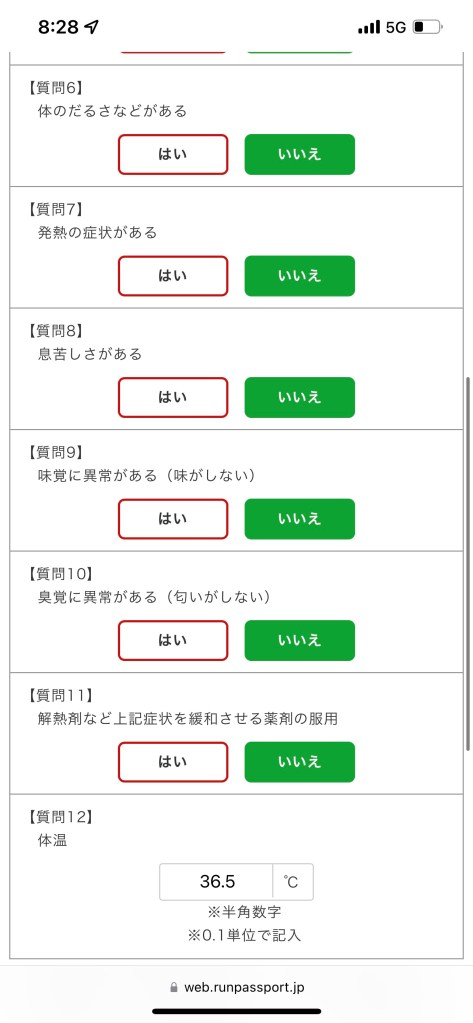
Of course, with Japan’s reluctance to let go of COVID restrictions, there was a lot of hand-holding leading up to the actual running. Every day for nine days, up until and including race day, runners had to fill out an online yes-no questionnaire (“My throat hurts,” “I can’t taste anything,” etc.) and log our temperature. I knew this was done to broadcast an air of safety and put our minds at ease, but, from my standpoint, it felt like they didn’t trust us to use common sense and not participate if we’re feeling sick. Can’t we, as adults, assess our own risk tolerance and decide if we’re comfortable being around thousands of other people, trusting that most people won’t show up sick? Whatever. I went along with the show, paranoid that I’d miss one of the daily check-ins and not be allowed to run. Funny how my temperature was always 36.5°. Every. Single. Day.
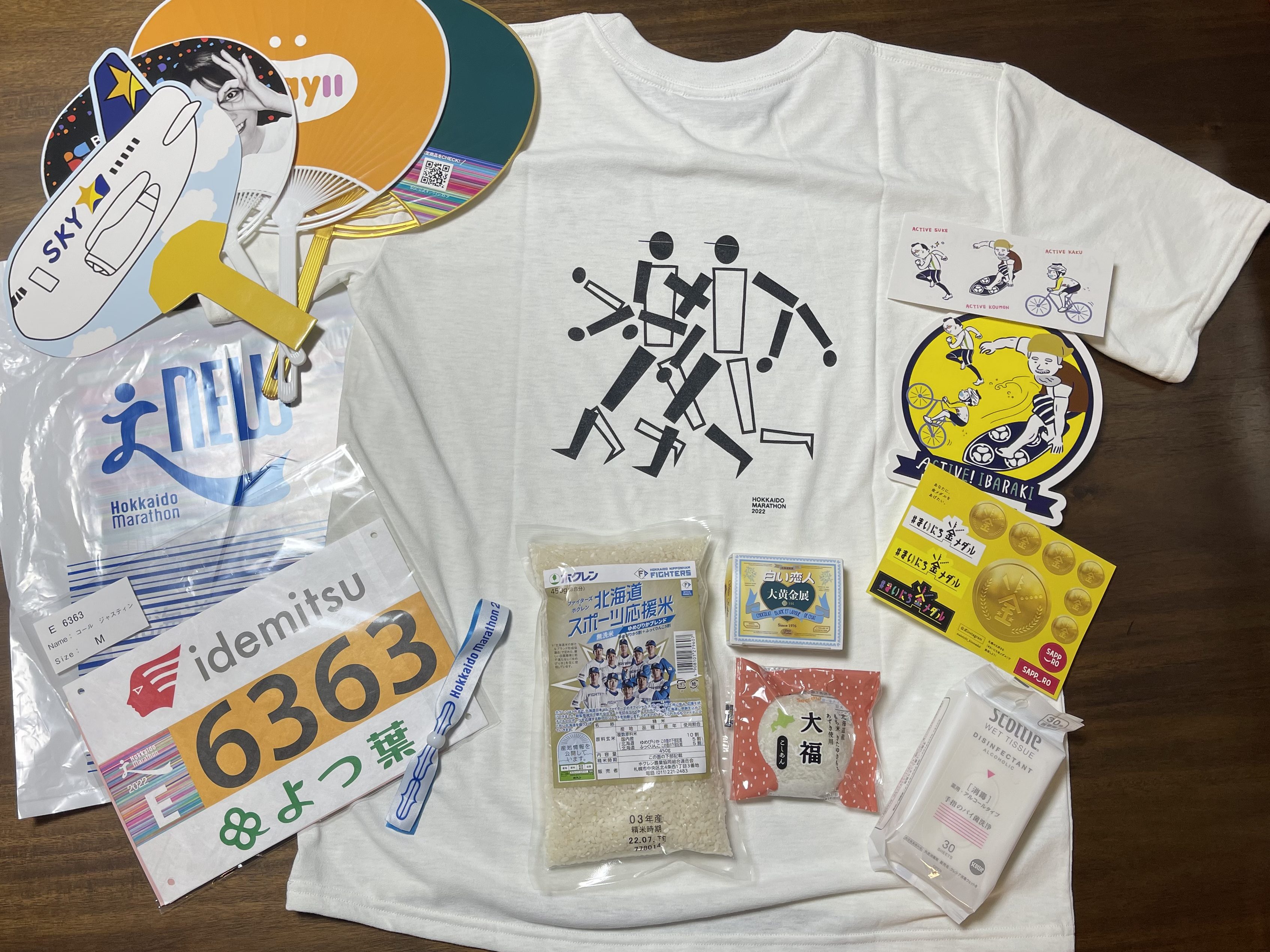
The packet pickup and race expo was at Odori Park, a multi-block green space in the center of downtown Sapporo, and was filled with the typical collection of sponsor booths. Showing the staff a QR code that was linked to my daily heath check-ins, I got a dope shirt (seriously one of the best-designed race shirts I’ve seen), two bibs (to be worn on the front and back race day), and a race timing chip to attach to my shoes. Not sure why they don’t use the timing chips that go on the inside of your bib like most races do. After that I went down the line to get a set of goodies provided by race organizers. There was a bracelet, a package of disinfecting hand wipes, mochi rice cake and… a 450g bag of rice? I kept on thinking this is sooooo Japanese. Not just the rice itself but the practicality of the things they gave out (apart from the bracelet). These are things I can use, and freebies like this are common here (I recently got some toilet paper when I bought a fridge). And since I brought my kids with me, I ended up getting three of everything. Clean hands and full tummies for weeks!
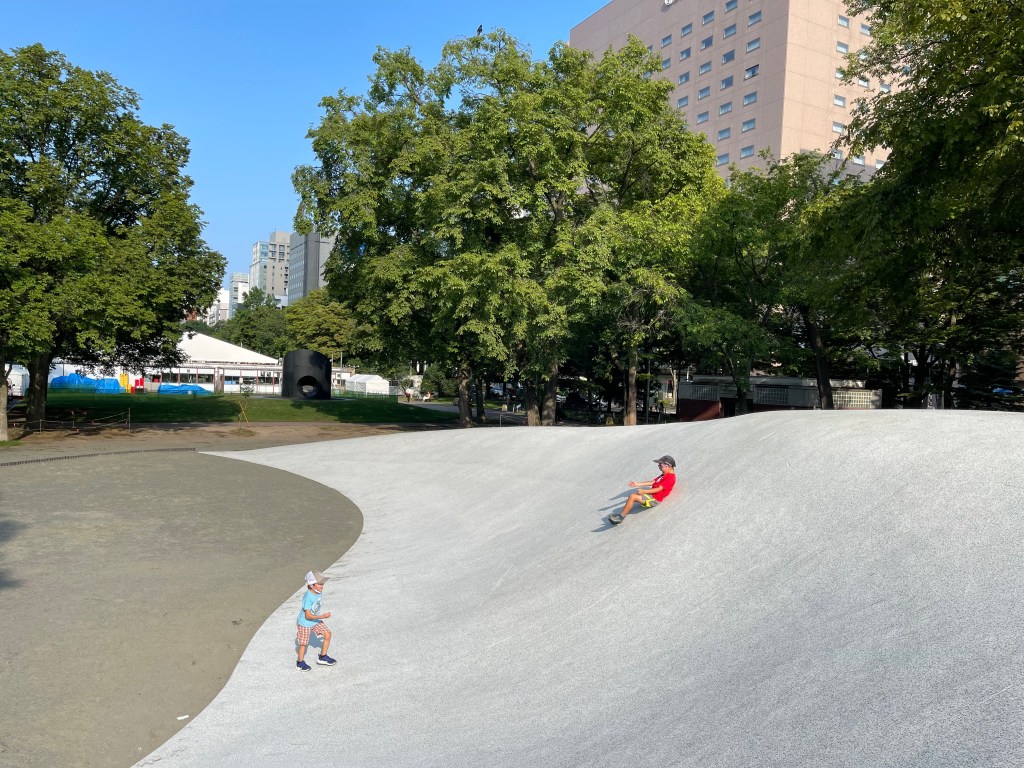
Back at the expo, there were lots of places to take my picture next to signage advertising various companies, and everyone was handing out plastic fans (more advertising), but I really only remember two of the booths: Shiroi Koibito (a chocolate company) because of the free chocolate and Bell System24 (a call center outsourcing company) because they refused to give me a bottle of water unless I liked their Instagram page (I said I was out of data, which was true, and they just smiled and still didn’t give me the water, fml it was hot out). I hightailed it out of the expo and took the kids to the ever awesome Black and White Slide behind packet pickup.
I seem to have bad luck when it comes to training for anything other than ultras. A partial tear in my right quad forced me to rest for weeks leading up to the San Diego RnR Marathon last year, and then I got plantar fasciitis in both feet because my shoes were too tight during the race. I contracted what was probably COVID (though I never tested positive) a couple weeks before the Carlsbad 5000 in May and ran while still recovering. So, even after a spectacular buildup to 100 km a week in training, I wasn’t surprised when my left achilles said it’d had enough just two weeks before the Hokkaido Marathon. I took it easy and hoped for the best.
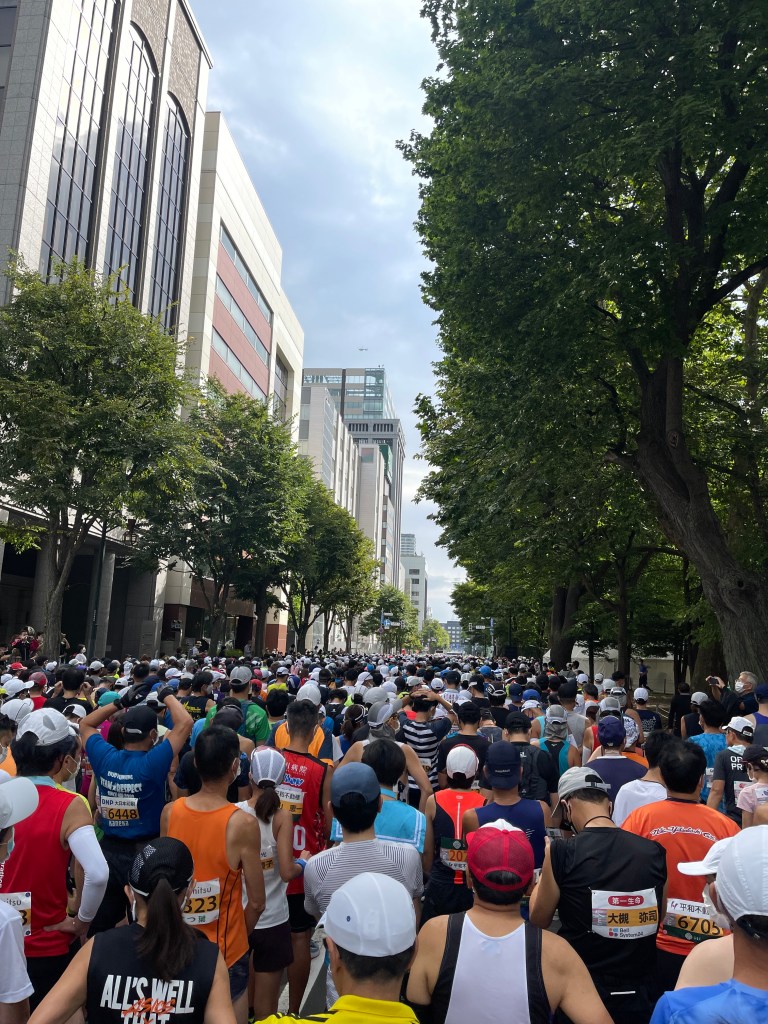
The weather was great on race day with a brief drizzle early in the morning clearing up to 23° cloudy conditions. After a long wait to use the restroom, I proceeded to my corral to warm up. We were told to keep our masks on until the race began, which virtually everyone did. I was in corral E, smack dab in the middle of 20,000 runners arranged by target running time. The organizers said the race would be a wave start to provide social distancing, so I pictured something like the freeway on-ramp traffic lights (one runner along a row goes when the light turns green) they had at the San Diego RnR Marathon. Instead, each corral merged with the one ahead of it and, after a little speech and countdown for the elite runners, we were off—social distancing be damned! Masks were awkwardly removed with nowhere to put them and it was wall-to-wall people for all but the last .2 of the next 42.2 kilometers.
The first 10 km and final 4 km, sharing the 2020 Tokyo Olympics marathon route (where they ran three laps), were definitely the highlight of the course. The start line took us south from Odori Park to Susukino (the nightlife district) and alongside Nakajima Park. We skirted the southern edge of downtown Sapporo before swinging back north toward Odori. I wasn’t too familiar with the area past Nakajima Park, but there were so many buildings and people cheering us on that the kilometers clicked by. There weren’t any water stations until about 6 km in, which would be fine if this were a 10k, but I was pretty thirsty at that point and a little worried I’d get behind on my hydration. At 9 km, the course took us through a kilometer-long tunnel below Odori Park. It was pretty cool hearing the footsteps of thousands of people reverberate off the asphalt and concrete walls, at least until the lack of airflow caught up with me and I could feel myself overheating. By the time I exited the tunnel, my head was pounding. My family was waiting nearby, though we couldn’t find each other, and they later said that all the runners seemed really sweaty for only 10 km into the race.
About 5 min after exiting the tunnel, we had our first sponge aid station. I read that they prepared 1.44 million (yes, million) paper cups for the race. Unlike a lot of races in the U.S., which encourage/require bringing your own collapsable cup, they don’t seem very concerned about trash here. Even worse were the sponges. At the size of a supermarket paperback and made from synthetic materials, seeing thousands of them littering the ground and overflowing from trash cans was disconcerting. I went to get one for myself (that tunnel was hot!) but so many had fallen onto the ground in front of the table that I veered away as people ahead of me tripped and slid over them. When I did finally get one at a different aid station, it had dried up from sitting there so long that it felt like sandpaper scraping at my salt-crusted skin. I stuck with dousing myself with water from paper cups for the rest of the course, hoping the cups would be recycled and not incinerated.
From the 15 km mark, the long slog began. With all the character that Odori Park, Susukino, and Sapporo Station have, you only have to get a couple blocks away before all the monotone apartment buildings and Lawsons look like Anywhere Japan. It’s a sad truth that most cities in Japan are largely indistinguishable from one another. This may be even more true of Sapporo since it’s only been around for about 100 years and lacks historical sites older than that. So I dug in and, at the 20 km point when we finally got some food, I was on track to get a sub-4. Until it fell apart. Maybe the lack of scenery (generic buildings gave way to generic fields) started to get to me. Maybe, as a trail runner, I expected too much from the view and terrain. Maybe I was just tired. Either way, the half a banana (what I would discover was the only food available at aid stations) I ate did little to lift my spirits. From 26 km on, I was questioning my life choices.
I never cease to be amazed at how unpredictable long distance running is. A niggle going in can be nothing at all or completely derail you. My sore achilles ended up being fine and, instead, my inner thighs and hamstrings on both legs decided to cramp, reducing me to a run/walk routine for the last 15 km of the race. By the time I made it to Hokkaido University and had only a few kilometers to go, my body had added side stitches to the mix and I could hardly care about the lovely elm trees that lined the road or meandering stream nearby. It was around this point, as I was attempting to elevate my shuffle into something resembling a run, that someone yelled out to me. “Richard-san! Richard-san!” a college-aged man shouted, waving a hand high in the air. I waved back and gave what must have been a bewildered smile, as no part of my name contains a Richard. He pointed at his camera and ran forward, dropping to a knee to take a rapid-fire succession of shots. I thew up a peace sign and gave the biggest smile I could muster while laughing to myself as I imagined what the actual Richard-san would say when he saw “his” picture.
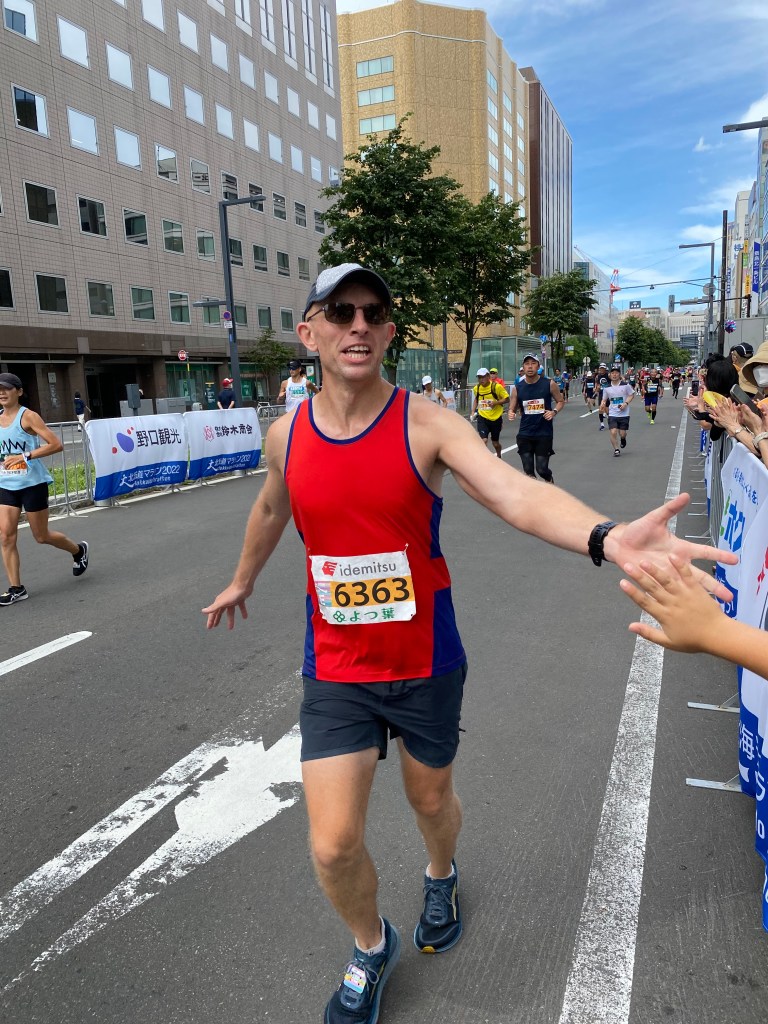
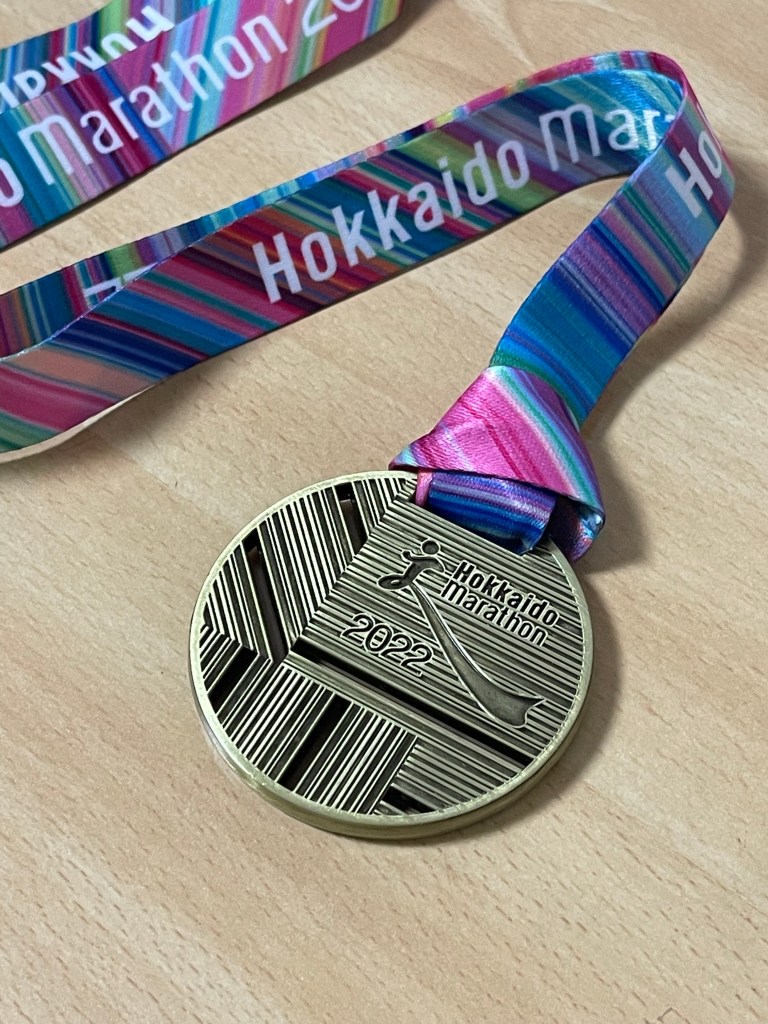
The last 200 meters, as with every long distance race, were glorious. I turned onto the street that runs from Sapporo Station to Odori Park, crowds five people deep cheering us on, the finish line straight ahead, and ran as hard as I could. I finally saw my family, gave them high-fives as they hollered Sprint! Go for it! and felt every muscle in my body hiss in pain as I tried to make it look like I’d been running this hard for the entire race. I missed my target time but still shaved 26 min off my PR. Then it was face mask, medal, finisher towel, bottle of water, and ice shower (ruining the face mask). I met up with my family, ate my 17th banana of the day, got some real food at a Family Mart (best damn onigiri and fried chicken EVER), and even got a free massage from a center for the visually impaired (seriously awesome—super nice guy, got to keep the towel, and a little café au lait to drink afterwards). Surprisingly, I could walk fine and was injury-free. Yay!
Now that it’s been a few days since the race, what do I think of it all? Would I run it again? No, I probably won’t, but not because it wasn’t fun. The energy from all the people cheering us on, along with seeing more of Sapporo and sharing this challenging experience with so many people, was amazing. There were 4,400 volunteers who made this race happen and I’m so thankful to every one of them. But, even with all the people coming together to support us, the Hokkaido Marathon was also an impersonal experience focused heavily on elite runners. When I saw the elite and sub-elite runners coming back from the turn around point, all of us average runners were cheering them on to go for it and keep pushing. But the elites didn’t even look our way. They even had their own water stations with their “special drinks” that came before the water and banana ones for us. And of course these top runners were nowhere to be seen by the time I crossed the finish. Compare this to a race like the Sean O’ Brien 50 Miler & 100k, where elite runners like Jeff Browning and Jesse Haynes cheered me on when we crossed paths and hung out at the finish line until late at night to see us regulars finish, and the Hokkaido Marathon feels like an entirely different type of event. Which it is. It’s fun for what it is, but I prefer the camaraderie, views, and food (why were there so many bananas!?) of a trail race. Perhaps I should see what those are like in Japan…
 The Everyday Essayist