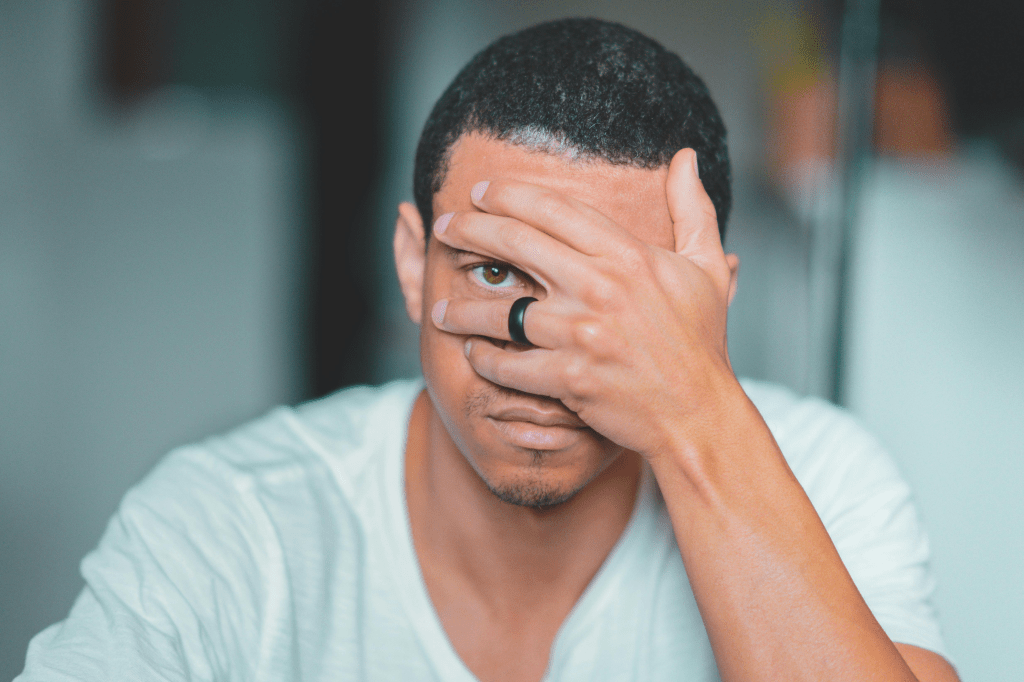
A friend’s blog post on being an Asian girl in a White world had me reflecting on how people like me (i.e., non-Asians) are treated here in Japan. As a white guy in an Asian world, it will come as no surprise that I get stared at. A lot. Everywhere I go, old people break their necks gawking at me, little kids lock their eyes on me like they’re about to launch laser-guided missiles, and everyone of every age in between stares wide-eyed and mouth agape as though they’d never seen a white guy before. (I write this recognizing that as a white, American man, I’m undoubtedly on top of the minority hierarchy here.)
I tell myself they can’t help but look. I consider myself of middling size and average features back home, but here I may as well be a giant space alien for how much I stand out. It’s only natural they’d stare. It’s instinctive. They’re not staring out of ill intent, I remind myself. But then again, maybe they are. Maybe that guy in the too-small suit is one of those right-wing loonies who holds a grudge against the United States for a war that happened long before he was born, or that old man giving me the stink eye thinks I’m yet another foreigner diluting the Japanese gene pool, or that group of snickering school girls caught me making a cultural faux pas that even a preschooler wouldn’t make. I don’t know what they’re all thinking. Who knows what anyone is thinking?
Staring isn’t benign. It may originate in curiosity, but to stare is to challenge, to draw attention to a perceived misgiving and set one’s will against another’s. There’s something animal in the response to being stared at, a gut instinct formed in our human ancestors long before language mediated actions. When I involuntarily think What the fuck you looking at?, I’m not using my evolutionarily-young frontal cortex to respond to their gaze—I’m an animal facing another animal ready to pounce.
I’ve tried several tactics in dealing with stares.
The “Nani?” Approach. I say “What?” and throw back my chin. Result: They never respond and look at me confused/scared/about to call the cops.
The Mirror Approach. I stare back at them, mirroring their gaze. Result: They avert their eyes and act like they totally weren’t just looking at me, or we both break our necks turning to look at each other in the most awkward staring contest ever.
The Ignoring Approach. I pretend they’re not staring at me and let them look. Result: This is the most harmonious method. Though the stress of walking around with blinders, as though I were an animal in a zoo trying trick myself into thinking this is the savannah, is exhausting in its own right.
The Hello! Approach. Say Hello! with the happiest, most stereotypical American attitude I can muster. Result: I can never say it without a heavy dose of sarcasm, and I end up being embarrassed by the rare, earnest hello I receive in return (reminding myself once again that sarcasm has yet to be invented here).
Regardless of which approach I take, I find being in public enervating and enraging.
Imagine this for a moment: no matter where you go—on the street, aboard a train or in your own car, in shops, restaurants, public restrooms, even atop the summit of a mountain—everyone you see either openly stares at you or has that look on their face that tells you they see you. You are seen. Everywhere and always. You are not like everyone else. You’re the Other.
(I tried embracing my otherness last summer by going for a shirtless bike ride. I figured that doing something that actually warrants a second glance would purge me of concern for all the day-to-day attention I receive. For while running or cycling shirtless in SoCal rarely elicits even a raised eyebrow, you may as well be buck naked without a shirt on in Japan. Most people even going swimming with shirts on. The experiment actually worked for a bit, creating a stare-proof armor on my psyche, but I wasn’t inclined to do it again after the feeling wore off.)
Even though I understand people’s reasons for staring, that it’s instinctive and not (necessarily) malicious, I can’t get past it. Is this what movie stars and incredibly attractive people feel like? Should I be flattered? I am an outsider here in Japan, no matter how good my Japanese becomes or how much I tie myself to this place, so perhaps it just comes with the territory. I should accept it and let it be. I shouldkeep it from getting to me. I shouldjust move on. Just as other people shouldn’tstare. I can’t change people’s actions and thoughts toward me nor how I instinctively respond to them, and I don’t know what to do with that.
View from Odori Park, where the race starts and finishes
The first Hokkaido Marathon was run in 1987 and had only 439 entrants. This year the race was capped at just over 20,000 runners. It’s by far the largest marathon in Hokkaido, the only major marathon in Japan to be held in summer, and has a reputation for being difficult with a strict 6 hour cut-off (up from 5 hours previous years). And after being cancelled in 2020 and 2021, and with the 2020 Tokyo Olympics marathon having been run on much of the same course, excitement was high for this year’s race. For myself, this being my first race in Japan, I was curious to see how marathons here differ from those in the U.S.
I signed up for the race back in March and gained entry under a lottery system in April, giving me a good four months to train properly. After running the Sean O’ Brien 50 Miler in February and Del Dios 50k the month before that, I knew I needed to add some speed to my regimen, so I worked in a 10k and 5k race in the buildup to the marathon. This was my second proper marathon after last year’s San Diego Rock n’ Roll Marathon, which I ran injured and finished with a different injury (naturally), and I was hoping to improve on that performance in both training and the race itself.
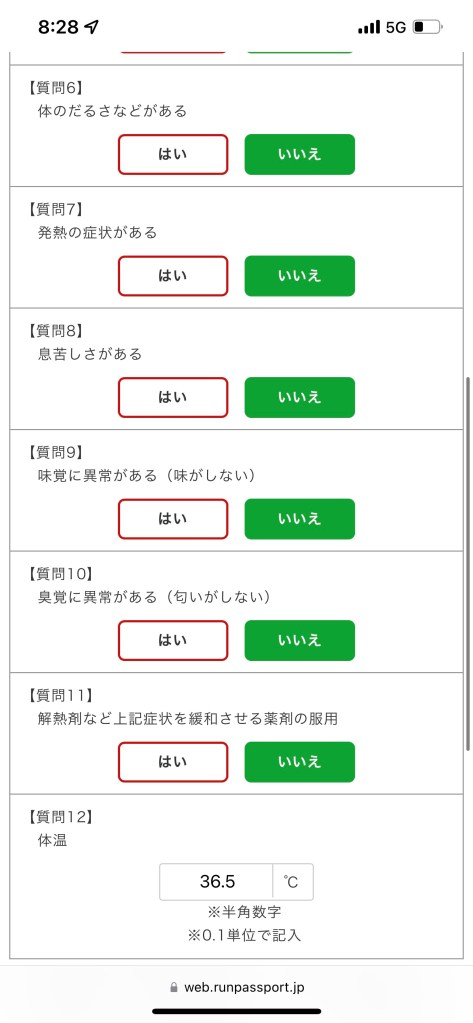
Of course, with Japan’s reluctance to let go of COVID restrictions, there was a lot of hand-holding leading up to the actual running. Every day for nine days, up until and including race day, runners had to fill out an online yes-no questionnaire (“My throat hurts,” “I can’t taste anything,” etc.) and log our temperature. I knew this was done to broadcast an air of safety and put our minds at ease, but, from my standpoint, it felt like they didn’t trust us to use common sense and not participate if we’re feeling sick. Can’t we, as adults, assess our own risk tolerance and decide if we’re comfortable being around thousands of other people, trusting that most people won’t show up sick? Whatever. I went along with the show, paranoid that I’d miss one of the daily check-ins and not be allowed to run. Funny how my temperature was always 36.5°. Every. Single. Day.
Screenshot of the daily health check-in we had to fill out
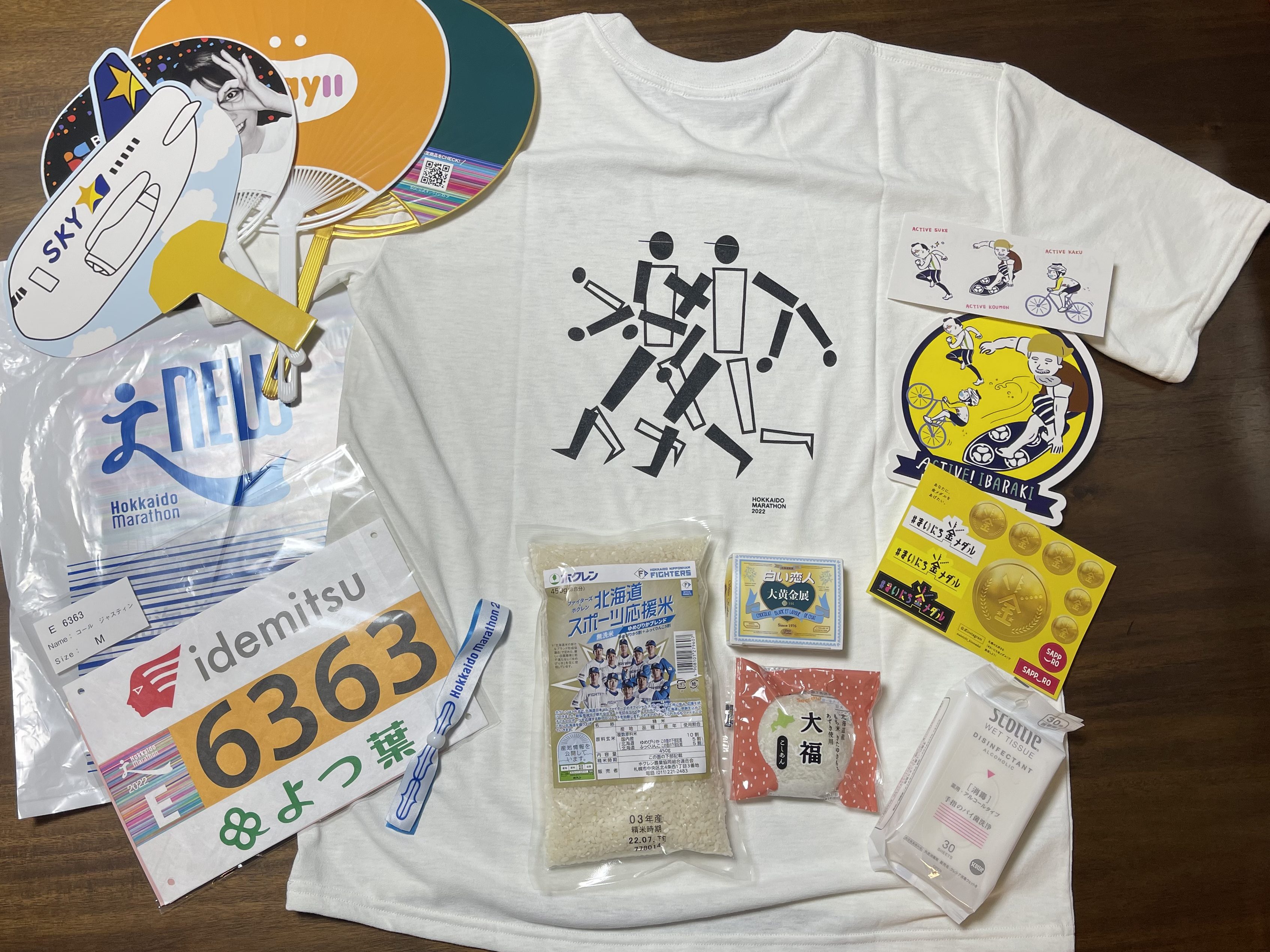
The packet pickup and race expo was at Odori Park, a multi-block green space in the center of downtown Sapporo, and was filled with the typical collection of sponsor booths. Showing the staff a QR code that was linked to my daily heath check-ins, I got a dope shirt (seriously one of the best-designed race shirts I’ve seen), two bibs (to be worn on the front and back race day), and a race timing chip to attach to my shoes. Not sure why they don’t use the timing chips that go on the inside of your bib like most races do. After that I went down the line to get a set of goodies provided by race organizers. There was a bracelet, a package of disinfecting hand wipes, mochi rice cake and… a 450g bag of rice? I kept on thinking this is sooooo Japanese. Not just the rice itself but the practicality of the things they gave out (apart from the bracelet). These are things I can use, and freebies like this are common here (I recently got some toilet paper when I bought a fridge). And since I brought my kids with me, I ended up getting three of everything. Clean hands and full tummies for weeks!
Race goodies
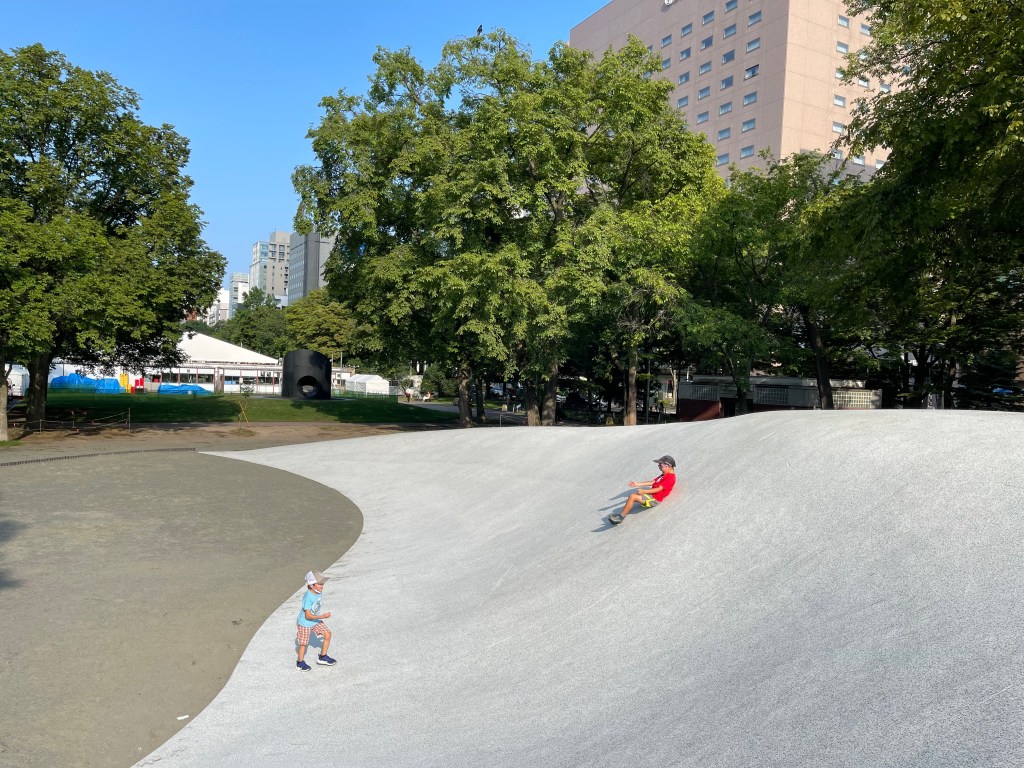
Back at the expo, there were lots of places to take my picture next to signage advertising various companies, and everyone was handing out plastic fans (more advertising), but I really only remember two of the booths: Shiroi Koibito (a chocolate company) because of the free chocolate and Bell System24 (a call center outsourcing company) because they refused to give me a bottle of water unless I liked their Instagram page (I said I was out of data, which was true, and they just smiled and still didn’t give me the water, fml it was hot out). I hightailed it out of the expo and took the kids to the ever awesome Black and White Slide behind packet pickup.
White Slide with Black Slide in background
I seem to have bad luck when it comes to training for anything other than ultras. A partial tear in my right quad forced me to rest for weeks leading up to the San Diego RnR Marathon last year, and then I got plantar fasciitis in both feet because my shoes were too tight during the race. I contracted what was probably COVID (though I never tested positive) a couple weeks before the Carlsbad 5000 in May and ran while still recovering. So, even after a spectacular buildup to 100 km a week in training, I wasn’t surprised when my left achilles said it’d had enough just two weeks before the Hokkaido Marathon. I took it easy and hoped for the best.
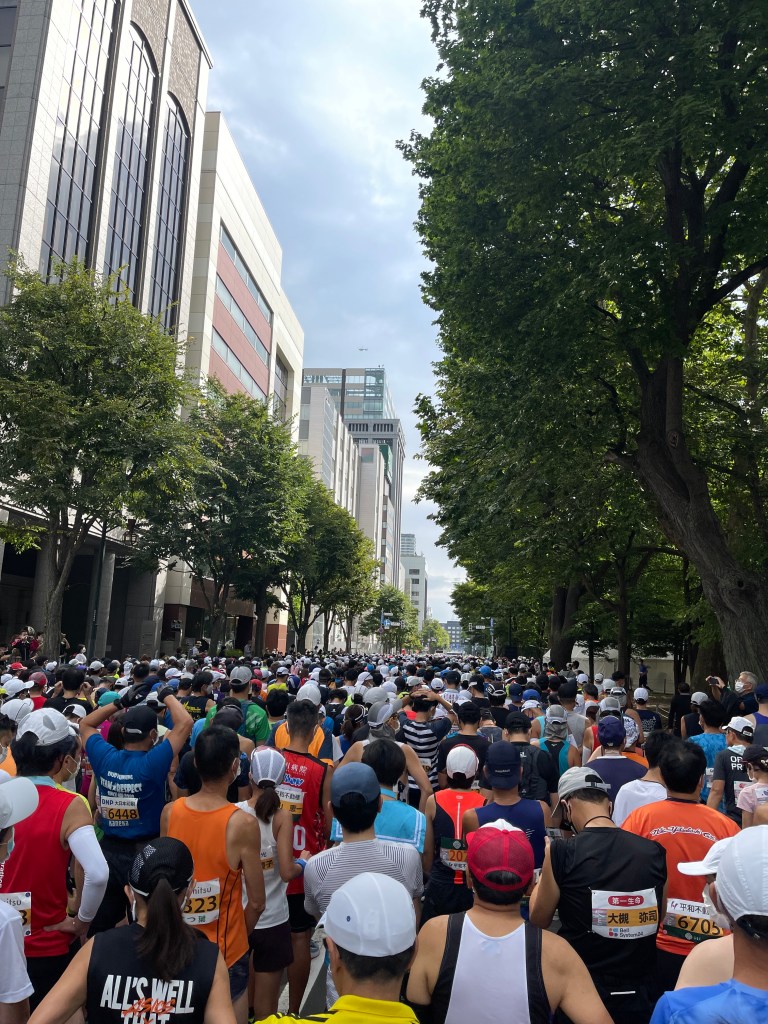
The weather was great on race day with a brief drizzle early in the morning clearing up to 23° cloudy conditions. After a long wait to use the restroom, I proceeded to my corral to warm up. We were told to keep our masks on until the race began, which virtually everyone did. I was in corral E, smack dab in the middle of 20,000 runners arranged by target running time. The organizers said the race would be a wave start to provide social distancing, so I pictured something like the freeway on-ramp traffic lights (one runner along a row goes when the light turns green) they had at the San Diego RnR Marathon. Instead, each corral merged with the one ahead of it and, after a little speech and countdown for the elite runners, we were off—social distancing be damned! Masks were awkwardly removed with nowhere to put them and it was wall-to-wall people for all but the last .2 of the next 42.2 kilometers.
A sea of polyester and anxious feet
The first 10 km and final 4 km, sharing the 2020 Tokyo Olympics marathon route (where they ran three laps), were definitely the highlight of the course. The start line took us south from Odori Park to Susukino (the nightlife district) and alongside Nakajima Park. We skirted the southern edge of downtown Sapporo before swinging back north toward Odori. I wasn’t too familiar with the area past Nakajima Park, but there were so many buildings and people cheering us on that the kilometers clicked by. There weren’t any water stations until about 6 km in, which would be fine if this were a 10k, but I was pretty thirsty at that point and a little worried I’d get behind on my hydration. At 9 km, the course took us through a kilometer-long tunnel below Odori Park. It was pretty cool hearing the footsteps of thousands of people reverberate off the asphalt and concrete walls, at least until the lack of airflow caught up with me and I could feel myself overheating. By the time I exited the tunnel, my head was pounding. My family was waiting nearby, though we couldn’t find each other, and they later said that all the runners seemed really sweaty for only 10 km into the race.
About 5 min after exiting the tunnel, we had our first sponge aid station. I read that they prepared 1.44 million (yes, million) paper cups for the race. Unlike a lot of races in the U.S., which encourage/require bringing your own collapsable cup, they don’t seem very concerned about trash here. Even worse were the sponges. At the size of a supermarket paperback and made from synthetic materials, seeing thousands of them littering the ground and overflowing from trash cans was disconcerting. I went to get one for myself (that tunnel was hot!) but so many had fallen onto the ground in front of the table that I veered away as people ahead of me tripped and slid over them. When I did finally get one at a different aid station, it had dried up from sitting there so long that it felt like sandpaper scraping at my salt-crusted skin. I stuck with dousing myself with water from paper cups for the rest of the course, hoping the cups would be recycled and not incinerated.
From the 15 km mark, the long slog began. With all the character that Odori Park, Susukino, and Sapporo Station have, you only have to get a couple blocks away before all the monotone apartment buildings and Lawsons look like Anywhere Japan. It’s a sad truth that most cities in Japan are largely indistinguishable from one another. This may be even more true of Sapporo since it’s only been around for about 100 years and lacks historical sites older than that. So I dug in and, at the 20 km point when we finally got some food, I was on track to get a sub-4. Until it fell apart. Maybe the lack of scenery (generic buildings gave way to generic fields) started to get to me. Maybe, as a trail runner, I expected too much from the view and terrain. Maybe I was just tired. Either way, the half a banana (what I would discover was the only food available at aid stations) I ate did little to lift my spirits. From 26 km on, I was questioning my life choices.
I never cease to be amazed at how unpredictable long distance running is. A niggle going in can be nothing at all or completely derail you. My sore achilles ended up being fine and, instead, my inner thighs and hamstrings on both legs decided to cramp, reducing me to a run/walk routine for the last 15 km of the race. By the time I made it to Hokkaido University and had only a few kilometers to go, my body had added side stitches to the mix and I could hardly care about the lovely elm trees that lined the road or meandering stream nearby. It was around this point, as I was attempting to elevate my shuffle into something resembling a run, that someone yelled out to me. “Richard-san! Richard-san!” a college-aged man shouted, waving a hand high in the air. I waved back and gave what must have been a bewildered smile, as no part of my name contains a Richard. He pointed at his camera and ran forward, dropping to a knee to take a rapid-fire succession of shots. I thew up a peace sign and gave the biggest smile I could muster while laughing to myself as I imagined what the actual Richard-san would say when he saw “his” picture.
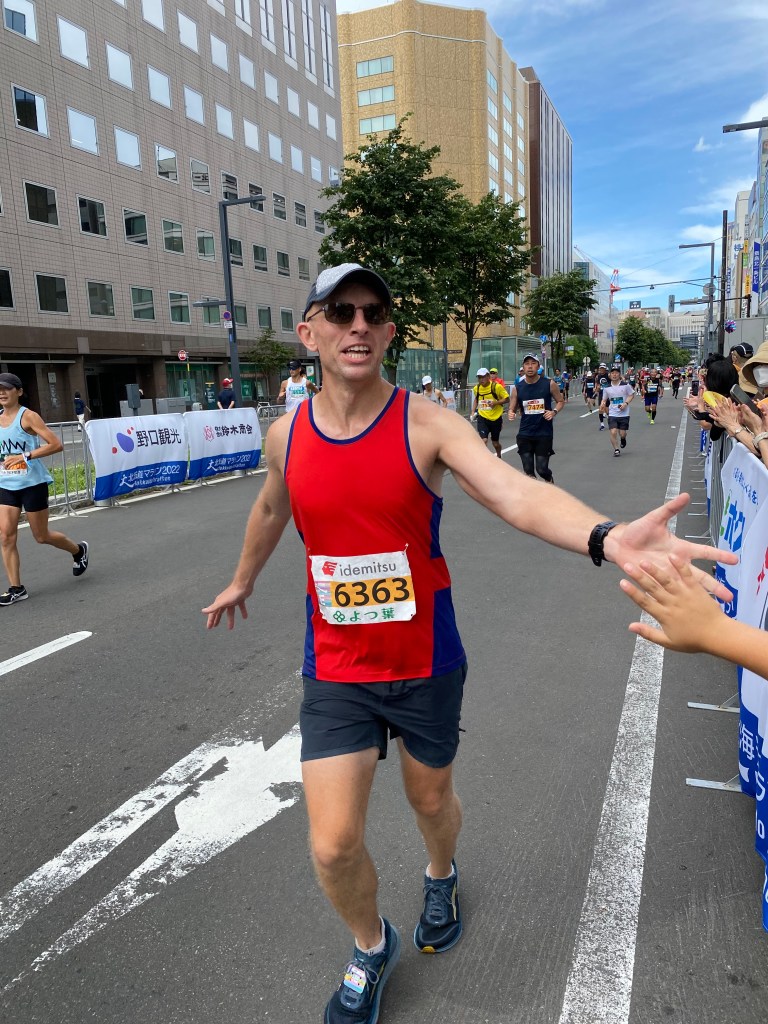
A physiognomic representation of extreme pain, exhaustion, and joy
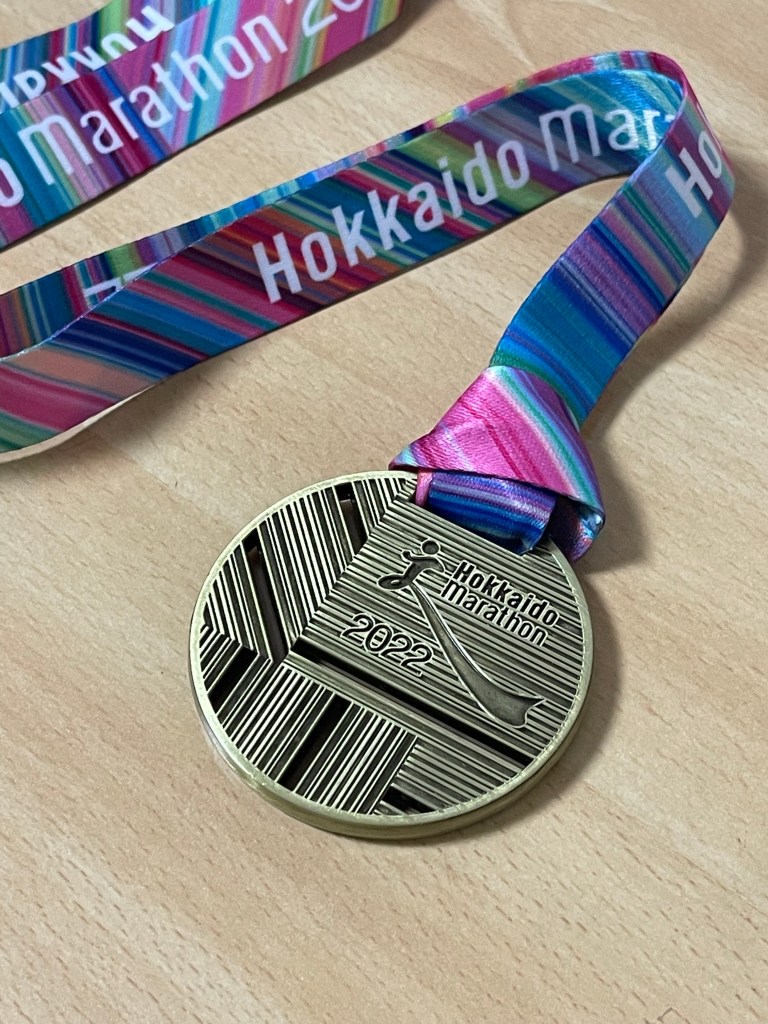
The last 200 meters, as with every long distance race, were glorious. I turned onto the street that runs from Sapporo Station to Odori Park, crowds five people deep cheering us on, the finish line straight ahead, and ran as hard as I could. I finally saw my family, gave them high-fives as they hollered Sprint! Go for it! and felt every muscle in my body hiss in pain as I tried to make it look like I’d been running this hard for the entire race. I missed my target time but still shaved 26 min off my PR. Then it was face mask, medal, finisher towel, bottle of water, and ice shower (ruining the face mask). I met up with my family, ate my 17th banana of the day, got some real food at a Family Mart (best damn onigiri and fried chicken EVER), and even got a free massage from a center for the visually impaired (seriously awesome—super nice guy, got to keep the towel, and a little café au lait to drink afterwards). Surprisingly, I could walk fine and was injury-free. Yay!
Now that it’s been a few days since the race, what do I think of it all? Would I run it again? No, I probably won’t, but not because it wasn’t fun. The energy from all the people cheering us on, along with seeing more of Sapporo and sharing this challenging experience with so many people, was amazing. There were 4,400 volunteers who made this race happen and I’m so thankful to every one of them. But, even with all the people coming together to support us, the Hokkaido Marathon was also an impersonal experience focused heavily on elite runners. When I saw the elite and sub-elite runners coming back from the turn around point, all of us average runners were cheering them on to go for it and keep pushing. But the elites didn’t even look our way. They even had their own water stations with their “special drinks” that came before the water and banana ones for us. And of course these top runners were nowhere to be seen by the time I crossed the finish. Compare this to a race like the Sean O’ Brien 50 Miler & 100k, where elite runners like Jeff Browning and Jesse Haynes cheered me on when we crossed paths and hung out at the finish line until late at night to see us regulars finish, and the Hokkaido Marathon feels like an entirely different type of event. Which it is. It’s fun for what it is, but I prefer the camaraderie, views, and food (why were there so many bananas!?) of a trail race. Perhaps I should see what those are like in Japan…
Although Japan was one of the first countries to experience just how disruptive the novel coronavirus is, as was seen in its inept handling of the Diamond Princess cruise ship incident in February 2020, residents here were (technically) spared one key containment strategy of the pandemic: lockdown. People living in Japan will tell you they never locked down during the pandemic. Restaurants were “asked” to close early and not serve alcohol after a certain time, companies were “encouraged” to have employees go remote (which usually meant working from home just once or twice a week), and social events were (and continue to be) cancelled out of an abundance of caution, but schools remained open and the government couldn’t, by law, force people to stay home. People were even free to travel abroad, knowing they’d be let back in, so long as they endured quarantine measures on return and were Japanese nationals.
It’s been nearly 900 days since Japan closed its borders to foreigners. There has been talk of opening the country back up for well over a year, rhetoric peaking predictably when case numbers are low. Each time, the government takes baby steps to let in business people or students, only to rescind opening measures when case numbers shoot back up. Opening talks ebb and flow to the whims of public opinion and electoral schedules as COVID variant waves come and go with little change in the status quo. Politicians don’t want to take responsibility for making decisions (an apparent prerequisite for the job on both sides of the Pacific) and no one wants to admit that the racist border measures are completely ineffective (i.e., SARS-CoV-2 doesn’t care what passport you carry and will gladly hitch a ride in a Japanese national’s nasal passages).
Will opening the country back up result in another COVID surge? Maybe. Probably. But the thing is, not opening up has done little-to-nothing to prevent surges. We’re in the midst of the biggest surge yet, hovering around 200,000 new cases daily for the past month, even though the borders are still closed and masking is near universal.
The dirty secret, which I think everyone knows, is that Japanese people in general don’t want to reopen. They’re reluctant to change and, quite frankly, don’t find everything about pre-pandemic life ideal.
I lived in Hawaii for two years in my twenties. Absolutely loved it. Beautiful place, nice people, great food. But my god, the tourists around Waikiki and Ala Moana were horrible. Especially the Japanese ones. Loud, rude, clueless about local etiquette, just a pain in the ass making the whole area uninviting for residents. But here’s the thing: tourists are horrible everywhere there are too many of them from the same country. Be it Americans in Paris, Chinese in Rome, or Japanese in Waikiki, the more there are the worse they behave. Your home becomes a zoo for their amusement and, in certain areas, you’re a caged animal in your own country.
That’s what changed here in Japan. All of the tourists disappeared and suddenly places like Kyoto and Nara weren’t overrun year round. Even here in Sapporo, where I used to see huge Chinese tour groups talking way too loudly and bumping into people as they bought name brand bags, it’s much more peaceful going shopping downtown or eating out. People who made a living off tourism continue to suffer, but for the average citizen it’s great. Traveling in-country during the pandemic is fantastic.
For three-quarters of people here, the status quo is preferable to the uncertainty of reopening. Japan is a risk-adverse society and it’s hard to predict exactly what will happen if they reopen. Hospitals (along with politicians’ spines) are easily strained, and concerns about the healthcare system being able to handle sick tourists, foreigners following mask guidelines, and the government being able manage an influx of visitors are all legitimate worries that may sway people away from favoring open borders. And, when the cards are on the table, I just don’t think Japanese people see being cut off from the world as a negative. For an already inward-looking country, closing the borders hasn’t been as catastrophic as some might assume.
Will Japan reopen? Sure, eventually. They can’t remain closed forever. But, when that day does come, I think many people won’t be happy about it.
In 2019, after living in Japan for five years, my family and I moved to San Diego, California, so I could attend an MFA in Creative Writing program. The pandemic hit seven months into our stay.
We all remember those first months. Disinfecting groceries (or wondering if we should). Stumbling off the sidewalk when someone passed by. Holding our breath in elevators. Thinking I’ll certainly be fine, but gripped by anxiety after reading stories of even young people dying. 2020 was a year none of us will forget, for all the worst reasons. I was so happy when it (and most of 2021) was over and I could return to in-person classes, visit family, see people’s faces and smile again. I remember going for a run when things were first getting better and a lady walking a dog, neither one of us with masks on, though most people still wore them, said that it was so nice to see someone’s smiling face again. I hadn’t even realized I was smiling. Her comment made me smile even more.
I graduated from my MFA program in May and, after much deliberation, we moved back to Japan last month. With news of shootings, drug overdoses, and a general sense of people being angrier, Japan seemed safer for our family.
BA.5 was just beginning to spike when we left San Diego, but most people hadn’t worn masks in ages. I certainly hadn’t. Some people do wear masks, as my parents who are over 65 thankfully do, and I’m glad that it’s easy to buy high quality ones now. All of my own family is vaxxed and boosted, so when it comes to COVID, we feel safe. It is, after all, not 2020 anymore.
Except in Japan.
In spite of high vaccination rates (though low booster uptake) and general good health, Japanese people are still masking everywhere. On public transportation. In grocery stores. At school. Walking down the street. Hiking up a windy mountain. In 30°C heat with 85% humidity. I’ve heard reports of there being more hospitalizations for heat related conditions than COVID early this summer. It doesn’t matter if there’s anyone else around, most people mask up before turning the handle on their front door to go out. And if they do remove or lower their mask, they’ll pull it back up the minute they see someone else. Never mind if the person is even nearby.
It’s all about visibility, about how you’re seen.
The social contract in Japan is extremely strong. Appearances are oftentimes more important than results. Literally being at work is more important than being productive at work. Having a law is more important than enforcing said law. Politeness exists before sincere kindness. To wear a mask is to signal that you’re one with the group, heat stroke and smiles be damned.
Japan has one of the lowest rates of death from COVID-19. I’m sure masking has played a role in that. But, as we’re seeing with the BA.5 surge, there are limits to their effectiveness. Japan is seeing some of the highest case numbers in the world currently, even with near-universal masking. Deaths have risen, too, though they’re nowhere near the rate of those in the U.S.
Across the world, COVID is still killing people in large numbers. Masking, to some degree, reduces the number of infections and subsequent deaths. But at what point is the cost of masking—difficulty breathing, increased risk of heat stroke, inability to read others’ emotions, emotional development impediments in children—too much? At what point does the non-lethal suffering of the group outweigh the added risk of unmasking to those who may die from COVID-19?
I’m sure there are cultural differences at work here. Perhaps most Japanese people don’t see hiding one’s face as all that different from the way they hide their true feelings from one another (i.e., tatemae vs. honne). Plenty of people wore masks before the pandemic to tame hay fever, prevent the spread of a cold or flu, hide bad teeth, or get away with not putting makeup on. The people I’ve asked about masking since moving back say they forget the mask is even on.
For me, though, masking drags me back to 2020, when I couldn’t stop clenching my jaw and had horrible TMJ pain, when masking meant I had to put myself in a risky situation, when I felt alone and trapped behind necessary but burdensome barriers. I knew that others felt the same way in the U.S. and that we were all relieved to toss the masks and see one another’s faces again. A mental burden was lifted and we could all, literally and figuratively, breathe easier.
I’m just not sure what to do when the people around me now are content with life circa 2020. Do I really have to go back to that year I’d rather forget? Does wanting to live life without a mask mean I’m selfish?

 The Everyday Essayist